
VenPays
A Bahrain-focused payment platform involving merchants, payment methods, transaction processing, APIs, and operational systems.
- Role
- Engineering & project ownership
- Type
- Payment platform
- Status
- Active
- Location
- Bahrain
Payment path
- Merchant
- Platform
- Payment Engine
- Payment Providers
- Events / Transactions
Overview
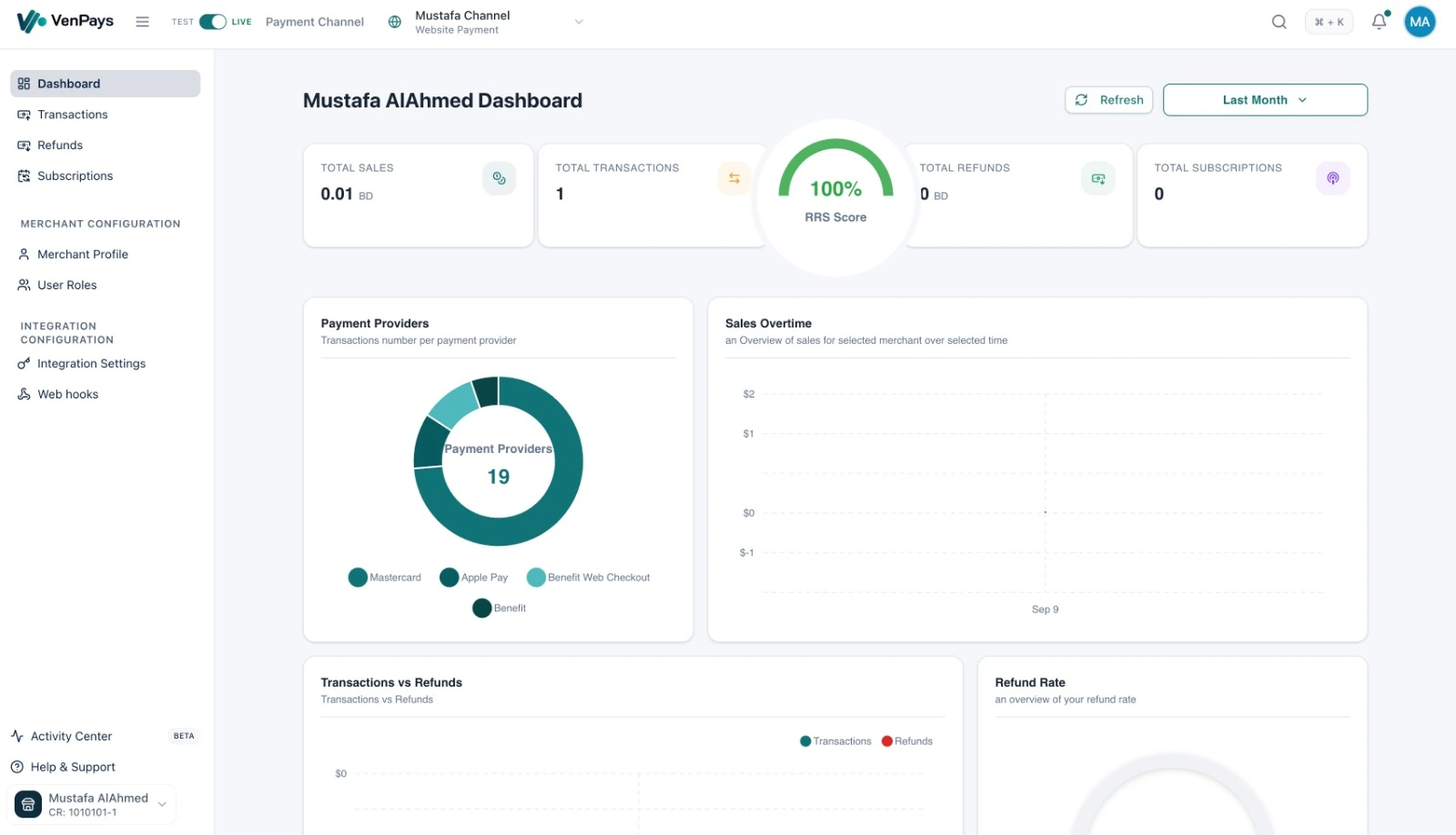
VenPays is a payment platform built for the Bahrain market. It connects merchants to payment methods through a central platform layer — covering transaction processing, APIs, and the operational systems needed to run payments in production.
The problem
Merchants need a reliable way to accept and operate payments across local and digital methods. That requires more than a checkout button: identity, organization structure, merchant configuration, environment separation, credential control, and visibility into what happens after a payment is attempted.
Payment platforms sit between business operations and external providers. Failures, edge cases, and access boundaries matter as much as the happy path.
My role
I contribute to payment platform engineering and take ownership across delivery — from systems work to making sure the product is coherent, testable, and operable.
System / Architecture
System structure
How merchants connect to payment providers through the platform boundary.
Engineering decisions
- 01
Environment isolation
Sandbox and live environments stay separated so merchants can integrate and test without putting production money movement at risk.
- 02
Credential lifecycle
API keys and access credentials need controlled states and clear ownership so integrations remain secure as teams and merchants change.
- 03
Payment events
Transaction state is modeled through events so the platform can reason about what happened — not only what was requested.
- 04
Access control
Organization, user, and merchant responsibilities are separated so operational access matches how the business actually works.
- 05
Operational visibility
Understanding failures matters as much as completing successful payments. Visibility into events and outcomes supports real operations.
Implementation
- Platform APIs for merchant and payment operations
- Provider integrations behind a payment engine boundary
- Configuration and environment controls for safe integration
- Operational surfaces for monitoring transaction and event state
Challenges
- Problem
Payment flows involve multiple actors and external providers with different behaviors.
ConstraintThe platform must remain coherent while providers and merchant setups differ.
DecisionKeep a clear platform boundary and model outcomes as events rather than treating every provider path as a one-off.
ResultIntegrations and operations can be reasoned about at the system level instead of only at the UI level.
- Problem
Credentials and environments are easy to mix up when teams move quickly.
ConstraintMistakes in live configuration have direct financial and trust impact.
DecisionTreat environment isolation and credential lifecycle as first-class system concerns.
ResultSafer integration paths and clearer operational ownership.
Outcome
A Bahrain-focused payment platform capability spanning merchants, methods, transaction processing, APIs, and operational systems — built to be integrated, operated, and owned as infrastructure rather than a one-off feature.
Lessons
- 01
Payment products are systems problems: identity, access, configuration, and events matter as much as the charge itself.
- 02
Ownership includes operability — if failures cannot be understood, the product is incomplete.
- 03
Clear boundaries between platform and providers make change safer over time.